
Become a Scuba Diving Instructor in Costa Rica in 2027: Your Complete Career Guide
Ready to turn your passion for diving into a career? Becoming a scuba diving instructor could be the beginning of a completely different life. More time in the ocean, opportunities to travel, an international community, and the chance to share something you love with people from all over the world.

But let's get one thing straight: becoming a dive instructor is about much more than collecting another certification card or spending a few weeks in paradise.
It's about developing the knowledge, teaching skills, confidence and professional experience to become a responsible dive instructor. It's about learning to manage students, solve problems, make decisions and deliver safe, enjoyable diving experiences.

If you're considering taking this step in 2027, Costa Rica is an excellent place to start.
At Rich Coast Diving, located in Playas del Coco, Guanacaste, we have been training dive professionals for more than 32 years. As the only SSI Career Center in Costa Rica, we offer a complete professional development pathway, from Divemaster training to Instructor Training and Instructor Evaluation.
And here's something that makes us particularly different: with two in-house SSI Instructor Trainers and an SSI Instructor Certifier on our team, you can complete your instructor training AND your final instructor evaluation with us, right here in Costa Rica.
Whether you're already a Divemaster, considering a career change or an experienced instructor looking to join SSI, here's everything you need to know about becoming a scuba diving instructor in Costa Rica in 2027.
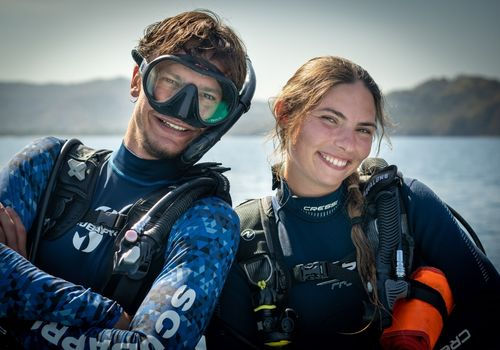
1. Why become a scuba diving instructor in 2027?
Let's start with the obvious question: why turn something you love doing into a job?
Because being a dive instructor opens doors to a lifestyle and career that very few other professions can offer.
Imagine starting your working day on a boat, teaching someone to breathe underwater for the first time, helping a nervous student overcome their fears, or sharing an incredible marine encounter with divers who have travelled halfway around the world to experience it.
But the diving industry offers much more than beautiful dive sites.

As a qualified dive instructor, you can:
Work in dive centers and resorts around the world.
Travel and experience different diving destinations.
Teach recreational scuba courses and specialties.
Work on liveaboards and in marine tourism.
Progress into technical diving, management or instructor training.
Get involved in marine conservation and environmental education.
Build an international career while doing something you genuinely enjoy.
Of course, diving professionally isn't a permanent vacation.
There are early mornings, equipment preparation, customer service, paperwork, changing weather conditions and a serious responsibility for your students' safety.
But if you enjoy working with people, being outdoors and spending your days in and around the ocean, it can be an incredibly rewarding career.
And no, you don't have to be 20 years old to make the change. We've trained candidates in their 30s, 40s and beyond. Previous professional experience, maturity, communication skills and the ability to work with people can actually be major advantages.

2. What are the requirements to become a scuba diving instructor?
Before enrolling in an SSI Instructor Training Course (ITC), you need to meet the professional prerequisites.
The main requirements for becoming an SSI Open Water Instructor include:

Hold an SSI Divemaster certification or an equivalent professional qualification from another recognized training organization.
Have a minimum of 100 logged dives before instructor certification.
Hold the required Diver Stress & Rescue certification.
Hold current React Right or equivalent First Aid, CPR and Oxygen Provider qualifications.
Meet the minimum age and medical fitness requirements.
Complete the required academic, practical and evaluation components.
Specific prerequisites and documentation requirements should always be confirmed with SSI and your Career Center before enrolling.

Already a PADI Divemaster?
Good news! You don't need to start your professional training all over again.
SSI welcomes qualified Divemasters from other recognized training organizations into its Instructor Training Course.
Whether you are a PADI, NAUI, CMAS or another recognized Divemaster, you can continue your professional development with SSI without repeating your entire Divemaster certification.
Your previous training and experience count. The next step is to meet SSI's instructor prerequisites and prepare for the ITC.

3. Divemaster to Instructor: Is it the right time to take the next step?
One of the questions we hear frequently is: Should I work as a Divemaster first, or should I become an instructor straight away? There isn't one answer that fits everyone.
Some Divemasters are ready to continue directly into instructor training. Others benefit from spending several months working in a dive center before taking the next step.
What matters most is not how quickly you collect certifications, but how prepared you are to work professionally.
As a Divemaster, you learn to guide certified divers, assist instructors, manage groups and understand dive operations.

As an instructor, your responsibilities expand significantly.
You need to teach people who have never dived before, assess their performance, demonstrate skills correctly, manage different learning styles and make decisions that directly affect their safety.
That requires more than good buoyancy and a high dive count.
At Rich Coast Diving, we believe that becoming a successful dive professional means developing practical skills alongside your certifications.
If you are not quite ready for the ITC, a longer Divemaster internship can help you gain the experience and confidence you need.
Our Divemaster Internship in Costa Rica focuses on more than completing training requirements. You'll learn how a professional dive center operates, work with international guests, assist instructors, prepare equipment, participate in dive operations and develop the skills employers actually look for.
As one of our former Divemaster candidates explained in his Divemaster Internship Experience, a certification card alone doesn't make you a confident professional. Real experience does.

4. Why choose Costa Rica for your Instructor Training Course?
There are many destinations around the world offering Instructor Training Courses. Thailand, Mexico, Indonesia and the Philippines are popular choices.
So why choose Costa Rica? Because your training environment matters.
Costa Rica's Pacific coast offers a dynamic diving environment where you can develop your skills in a variety of conditions. You won't just be training in a swimming pool and diving in the same sheltered bay every day.
In Playas del Coco, Guanacaste, you'll have access to a variety of dive sites in the Gulf of Papagayo, with different underwater landscapes, marine life and conditions.
Depending on the season, you may encounter:
Schools of tropical fish.
Sea turtles and eagle rays.
White-tip reef sharks.
Manta rays around the Catalinas Islands.
Bull sharks around the Bat Islands.
Moray eels, octopuses and a wide variety of marine invertebrates.

Beyond the diving, Playas del Coco is an established international diving destination.
You'll work with guests from different countries, communicate in an international environment and experience the day-to-day reality of a professional dive operation.
That's valuable preparation for a career in an industry where you might find yourself teaching students from five different countries in the same week.
Costa Rica is also a great place to enjoy your time outside training. Between the beaches, national parks, wildlife, surfing and outdoor activities, there's plenty to explore when you're not working on your instructor presentations.

5. What happens during an SSI Instructor Training Course?
The SSI Instructor Training Course (ITC) is designed to transform experienced Divemasters into confident, competent scuba instructors.
It's not simply about learning how to pass an examination. You'll learn how to teach, evaluate students, manage training sessions and apply SSI standards in real diving situations.
At Rich Coast Diving, our complete ITC and Instructor Evaluation program takes approximately 14 days, including accommodation.

6. Why choose Rich Coast Diving for your Instructor Course in Costa Rica?
Not all Instructor Training Courses are created equal. When comparing programs, it's easy to focus on the price or the number of days. But the quality of your training, the experience of your Instructor Trainers and the support you receive can make a much bigger difference to your future career.
Here's what makes our program different.

Two in-house SSI Instructor Trainers AND an SSI Instructor Certifier
This is one of our biggest advantages.
At Rich Coast Diving, you'll train with Céline Monfort and Niels Prinssen, both experienced SSI Instructor Trainers.
But we have something else that not every Career Center can offer: Niels is also an SSI Instructor Certifier. What does this mean for you?

Rich Coast Diving can offer the complete instructor development pathway in-house: Instructor Training Course AND Instructor Evaluation.
You can complete your professional training and your final instructor evaluation with our team in Playas del Coco, Costa Rica.
No need to organize another trip, travel to another country or find a separate center to complete your evaluation.
Having two Instructor Trainers and an Instructor Certifier within the same Career Center allows us to provide an integrated training experience, from your first teaching presentation to your final evaluation.

More than 32 years of experience training dive professionals
Rich Coast Diving has been training dive professionals for more than three decades.
We have helped hundreds of divers from around the world progress into professional diving careers.
We understand what dive centers expect from their instructors because we operate a busy dive center ourselves.
We don't just teach you how to pass the IE. We want you to be ready to work.

Small groups and personalized training
Instructor training requires practice, feedback and repetition.
We believe candidates benefit from having enough time to work on their individual strengths and weaknesses.
Our approach focuses on building confidence, improving teaching techniques and ensuring you understand the standards behind every presentation.
You're not just another candidate in a large group. We want to see you improve, develop and become a confident instructor.

Accommodation included
Relocating to another country for professional training involves more than paying for your course.
You also need to organize accommodation, transport and daily logistics.
Our complete Instructor Training Course and Evaluation program includes 14 days of accommodation, making it easier to focus on your training and enjoy your time in Costa Rica.

Career support and international connections
Passing your Instructor Evaluation is a major achievement, but it's also the beginning of your professional journey.
We provide career workshops, CV preparation, professional headshots and guidance on finding your first instructor position.
Over the years, we've built an international network of dive professionals and dive centers, helping our candidates connect with employment opportunities around the world.
Our objective is simple: we want you to leave Costa Rica ready to start working as a dive instructor.

7. SSI vs PADI: Which certification should you choose in 2027?
This is probably one of the biggest questions future instructors ask us.
Both SSI and PADI are internationally recognized training organizations. Both have established professional networks, comprehensive training standards and dive centers around the world.
So does it really matter which one you choose?
We believe it does, especially when you consider the long-term costs and benefits of being a dive professional.
We've worked with both organizations over the years. After more than three decades in the diving industry, we made the decision to transition our Career Center to SSI.
Here are some of the advantages that influenced our decision.

SSI Pro Rewards
SSI has a professional rewards program that gives instructors points when they certify divers.
These points have real financial value and can be used towards annual professional membership renewals or Professional Digital Kits.
New SSI professionals also benefit from free professional membership during their first calendar year and additional rewards points during their first full year, subject to the applicable program conditions.
This means that your teaching activity can help reduce your professional operating costs.

SSI One Fee Solution
One of the biggest advantages of SSI's professional structure is its One Fee Solution.
As an SSI Open Water Instructor, you can qualify to teach a range of additional SSI programs without paying separate annual or application fees for each teaching rating, subject to the relevant qualification requirements.
Depending on your qualifications, these can include programs such as Enriched Air Nitrox, Perfect Buoyancy, Marine Ecology and Explorers.
This makes it easier to expand your teaching portfolio without accumulating additional professional fees every time you want to develop a new specialty.

Digital teaching materials
SSI provides its professionals with access to digital student materials, instructor manuals, presentations, exams and updates through the MySSI platform.
Having these resources in one integrated system makes managing courses and staying up to date much easier.

International recognition and professional opportunities
SSI and PADI certifications are both recognized internationally.
Your choice should consider not only the initial training but also where you want to work, which agencies are represented in your preferred destinations and what ongoing professional support they offer.
We believe SSI offers excellent long-term value and a professional structure that benefits both instructors and dive centers.
For a more detailed comparison, read our articles:

8. Already a PADI Divemaster or Instructor? You can join SSI too!
Perhaps you're already an experienced PADI Divemaster or Instructor and wondering whether joining SSI would be beneficial.
You don't necessarily need to start your professional training all over again.
If you're a PADI Divemaster, you can enroll in the SSI Instructor Training Course, provided you meet the SSI prerequisites.
If you're already a PADI Instructor, SSI has an Instructor Onboarding Program for qualified professionals from other recognized training organizations.

The onboarding process includes selected ITC components and a mandatory Instructor Evaluation. It allows experienced instructors to become familiar with SSI's teaching methodology, standards and educational system before joining the SSI professional network.
At Rich Coast Diving, we welcome experienced instructors interested in transitioning to SSI.
We also believe that professional crossovers should be taken seriously. Understanding another organization's standards and teaching methodology is important, which is why the SSI onboarding process includes practical assessments rather than relying exclusively on online training.
If you're already an instructor and considering making the switch, contact us to discuss your qualifications and the available onboarding dates.
Read our guide: 10 Questions About the SSI Instructor Crossover Program.

9. What can you do after becoming a dive instructor?
Once you become an SSI Open Water Instructor, a whole new range of professional opportunities becomes available.
You can start teaching recreational scuba courses, building your experience and developing your professional portfolio.
As you gain experience, you can expand your qualifications through additional specialties and professional ratings.

Some possible career paths include:
Dive Center Instructor: Teach recreational courses and guide certified divers.
Resort Instructor: Work in an international holiday destination.
Liveaboard Instructor: Combine teaching and diving while travelling between dive sites.
Specialty Instructor: Develop expertise in areas such as Nitrox, Deep Diving, Navigation, Marine Ecology or Shark Ecology.
Advanced Professional: Progress towards Divemaster Instructor and other professional ratings.
Instructor Trainer: With the required experience and qualifications, progress into training future instructors.
You don't have to decide on your entire career path before becoming an instructor.
The important thing is to start with a solid foundation and keep developing your skills.

10. When can you become a dive instructor in Costa Rica in 2027?
Planning ahead is important, especially if you're travelling internationally for your professional training.
At Rich Coast Diving, we organize Instructor Training Courses throughout the year, coordinated with SSI Instructor Evaluation dates. Our complete program takes approximately 14 days, including the ITC, Instructor Evaluation and accommodation.
We recommend contacting us early to:
Check your professional prerequisites.
Confirm your logged dive count.
Verify your first aid and rescue qualifications.
Choose an available training date.
Organize your travel and accommodation.

Ready to become a scuba diving instructor in Costa Rica in 2027?
At Rich Coast Diving, we don't believe in simply getting candidates through an Instructor Evaluation as quickly as possible.
We believe in developing confident, knowledgeable and responsible dive professionals who are ready to work in the real world.
With two in-house SSI Instructor Trainers, an SSI Instructor Certifier, more than 32 years of experience training dive professionals, personalized training, accommodation and career support, we offer a complete pathway from Divemaster to certified SSI Open Water Instructor.
And yes, you can complete both your Instructor Training Course AND your Instructor Evaluation with us.
No need to travel somewhere else for your final evaluation. Train, prepare and get evaluated in the same Career Center, with a team that knows your progress from day one.
Your next chapter in diving could start in Costa Rica.
Get in touch with our team to discuss your prerequisites, the 2027 ITC dates and how to secure your place.

Rich Coast Diving – SSI Career CenterPlayas del Coco, Guanacaste, Costa Rica
Email: info@richcoastdiving.com
WhatsApp: +506 8449 4217
Stop dreaming about becoming a dive instructor. Start training for it.


Comments