
Shark Ecology: Understanding the Sharks You Can Dive With in Costa Rica
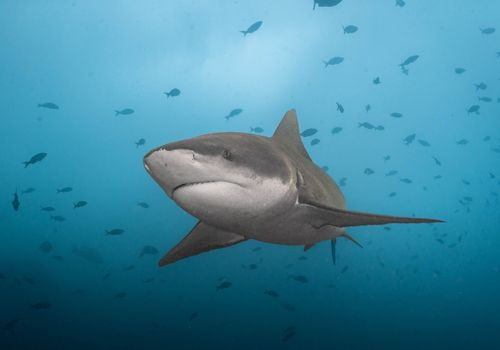
You descend into the blue at the Bat Islands. The volcanic pinnacle disappears beneath you, the Pacific stretches into the deep, and somewhere in the blue a bull shark appears.

For many divers, seeing a bull shark for the first time is an unforgettable experience. But understanding what you are looking at makes the encounter even more meaningful.
How does a shark behave? Why does it move the way it does? What role does it play in the ecosystem? And how can we observe these remarkable animals without disturbing their natural behavior?

That is where shark ecology comes in. At Rich Coast Diving in Playas del Coco, Costa Rica, you can complete the SSI Shark Ecology Specialty online and then put what you learn into practice while diving in the waters of the Gulf of Papagayo and, during the season, at the Bat Islands.

What is shark ecology?
Shark ecology is about understanding sharks as part of a larger marine ecosystem, not simply as animals that divers encounter underwater.
It looks at how sharks live, feed, reproduce and interact with their environment and other marine species. It also helps divers understand shark behavior and the important role that predators play in healthy ocean ecosystems.
The SSI Shark Ecology Specialty focuses on interpreting shark behavior, understanding why sharks are often misunderstood, learning about shark species and developing the knowledge needed to dive with sharks comfortably and responsibly.
The course is designed to be completed through digital learning, allowing you to study at your own pace. Many of our divers love the sharks they dive with and take the course. But also students and other people interested in sharks who might never come diving with us are taking the course online.

Especially those going on a shark diving trip in Egypt, Galapagos, Cocos Islands or other shark diving destinations. When taking the course with us in Costa Rica we add a classroom session. In this session we specifically talk about the sharks in Costa Rica and the conservation challenges they face.

Why learn about sharks before diving with them?
There is a big difference between simply seeing a shark and understanding what you are seeing.
Once you learn more about shark behavior, an encounter becomes an opportunity to observe rather than something to fear.
You may start noticing:
How the shark approaches and changes direction
How it uses the water column
How its body position and movement change
How it interacts with the environment
How different shark species behave differently
Why giving sharks space is important
How human behavior can affect wildlife encounters
The more you understand, the more interesting the dive becomes. And that is one of the reasons we love combining ecology education with diving at Rich Coast Diving.
Learn first. Then go see it for yourself.

Sharks you can encounter while diving in Costa Rica
The Pacific coast of Costa Rica is home to a remarkable variety of marine life. Around Playas del Coco and the Gulf of Papagayo, divers may encounter several species of sharks, depending on the dive site and conditions.

White-tip reef sharks
White-tip reef sharks are among the shark species you may encounter on local dives around Playas del Coco. These sharks are often seen resting around rocky areas or beneath overhangs and are a familiar part of the local underwater ecosystem.

For a diver learning about shark ecology, a local encounter is a great opportunity to observe shark behavior without travelling far from Coco. And because these are wild animals, every encounter is different.
Pacific nurse sharks
Pacific nurse sharks are another possible encounter in the region. They are seen occasionally rather than being a guaranteed part of a local dive.
Video: Pacific Nurse Shark Bats Islands in Costa Rica with Rich Coast Diving
They can also occasionally be encountered around the Bat Islands. Learning to recognize different shark species is one of the things that makes the SSI Shark Ecology Specialty particularly useful.
Once you know what you are looking at, you start paying attention to details that you might otherwise miss.

Bull sharks at the Bat Islands
Then there are the bull sharks. The Murciélago Archipelago, better known as the Bat Islands is one of Costa Rica's most exciting destinations for divers interested in sharks.

The famous bull shark dive site, known as Big Scare, lies in the remote waters of the archipelago. From Playas del Coco, the journey takes approximately 1.5 hours by boat. The Bat Islands are part of the protected area associated with Santa Rosa National Park and are known for their rich marine biodiversity.

Bull sharks (Carcharhinus leucas) are powerful, highly adaptable predators. One of their most unusual characteristics is their ability to tolerate low-salinity water, allowing them to use both marine and freshwater environments.
But seeing one underwater is very different from reading about one.

What is it like to dive with bull sharks at the Bat Islands?
A bull shark encounter at the Bat Islands is not a shark-feeding dive. At Rich Coast Diving, we do not feed the sharks. The objective is to observe them in their natural environment and avoid changing their behavior.
The main bull shark dive takes place at Big Scare. The second dive is normally at another site such as Black Rock, where divers can encounter large schools of fish and other pelagic marine life.
The conditions at the Bat Islands can be more demanding than local diving. Currents and swells can be strong, and visibility and conditions can change.
For this reason, Rich Coast Diving requires divers to be Advanced certified or equivalent and requires guests to complete a local dive before travelling to the Bat Islands. Valid dive insurance is also required for this remote trip.
Shark sightings are never guaranteed. They are wild animals, and that is exactly what makes an encounter meaningful.
When a bull shark appears from the blue, you are watching a wild predator in its natural environment, not an animal performing for divers.

How should divers behave around sharks?
Responsible shark diving starts with respect. The best shark encounter is one where the shark continues behaving naturally.
That means:
Do not chase sharks.
Do not touch them.
Do not feed them.
Maintain an appropriate distance.
Listen to your dive guide.
Stay aware of your surroundings.
Avoid actions that could change the animal's natural behavior.
The goal is not to get as close as possible. The goal is to observe. This is one of the most important lessons that ecology education can give a diver: wildlife encounters become more rewarding when we learn how to be better observers.
When all divers behave. The bullsharks get close. Very close ! Whatch the video below.
From seeing sharks to understanding their role in the ocean
Sharks are predators, but their importance goes far beyond the excitement they generate for divers. They are part of complex marine food webs and help shape the communities in which they live. Understanding sharks also means understanding the pressures they face.
Overfishing, habitat degradation, bycatch and other human impacts can affect shark populations around the world. Protecting sharks therefore means protecting the ecosystems they are part of.
At Rich Coast Diving, this connection between diving and conservation is particularly important to us.

Randall Arauz (CREMA) taking tissue samples from local reef sharks during our science expeditions. All our divers are involved in Coservation.
Our marine conservation programs in Playas del Coco combine ecological training, survey diving and collaboration with marine biologists. Our programs include structured fish surveys as well as focused shark and turtle conservation activities.
Take the SSI Shark Ecology Specialty
If you are fascinated by sharks, the SSI Shark Ecology Specialty is a great way to go beyond simply seeing them.
The course covers shark behavior, common shark species, their ecology and the reasons sharks are often misunderstood. SSI describes the program as a way to help divers become more comfortable and knowledgeable when diving with sharks.
At Rich Coast Diving, the SSI Ecology Specialties are available online, so you can complete the academic portion before your trip or while you are traveling.

Our current SSI Ecology Specialty booking includes:
Shark Ecology
Sea Turtle Ecology
Manta & Ray Ecology
Fish Identification
Marine Ecology
Coral Ecology
Marine Mammal Ecology
Nudibranch Ecology
Marine Invertebrate Ecology
The current course price is $85 USD, and the online program is designed to be completed at your own pace.
Ready to learn about sharks?
Put your new knowledge into practice
One of the best things about an ecology course is that you don't have to leave your new knowledge in the classroom. You can take it underwater. After studying Shark Ecology, join us for a local dive around Playas del Coco and look for white-tip reef sharks and other marine life. During bull shark season, take it one step further and join us for the Bat Islands.

The combination is what makes the experience special:
Learn about sharks → dive with sharks → understand why they matter.
If you are planning to dive at the Bat Islands, remember that this is a more demanding dive environment. Advanced certification or equivalent, a local dive beforehand and valid dive insurance are required.
Go beyond recreation: learn, dive and protect
For some divers, learning about sharks simply makes their holiday more interesting.
For others, it becomes the beginning of something much bigger.
At Rich Coast Diving, we offer marine conservation programs that allow divers to go beyond recreational diving and become involved in structured ecological training, survey diving and citizen science.
Our conservation programs include fish surveys, SSI Ecology Specialties and fieldwork with marine biologists, as well as focused shark and sea turtle conservation expeditions.
Shark diving is more meaningful when you understand what you are seeing
A shark encounter can last only a few minutes. But the knowledge you gain can change the way you look at the ocean for years. The next time you see a white-tip reef shark resting beneath a rocky ledge, a Pacific nurse shark moving through the reef, or a bull shark appearing from the blue at the Bat Islands, you won't just be seeing a shark.
You'll understand that you are looking at an important part of a much larger ecosystem.
And that is what marine ecology is really about.
Learn. Dive. Protect.
Ready to start?
SSI Shark Ecology Specialty NOW $85 USD
Or explore all of our diving and training options in the Rich Coast Diving Course Catalog.
If you are planning a bull shark trip, read our destination guide: Diving with Bull Sharks in Costa Rica's Bat Islands.



.png)
Comments